When pharmacy leaders compare centralized fulfillment vendors, the proposals usually land in the same place: a capital number, a footprint and a throughput promise. It’s tempting to line up the capital costs and pick the lowest that fits into the budget. That comparison leaves out the biggest cost of the system, which is the people it takes to run it.
Capital cost is only the first line to consider. A fulfillment system typically runs for a decade or more. Over that time, labor will quickly become the largest cost, and it’s set by design decisions made before anything is installed. Two systems with similar price tags can need very different staffing to hit the same volume.
Consider the system comparisons below:
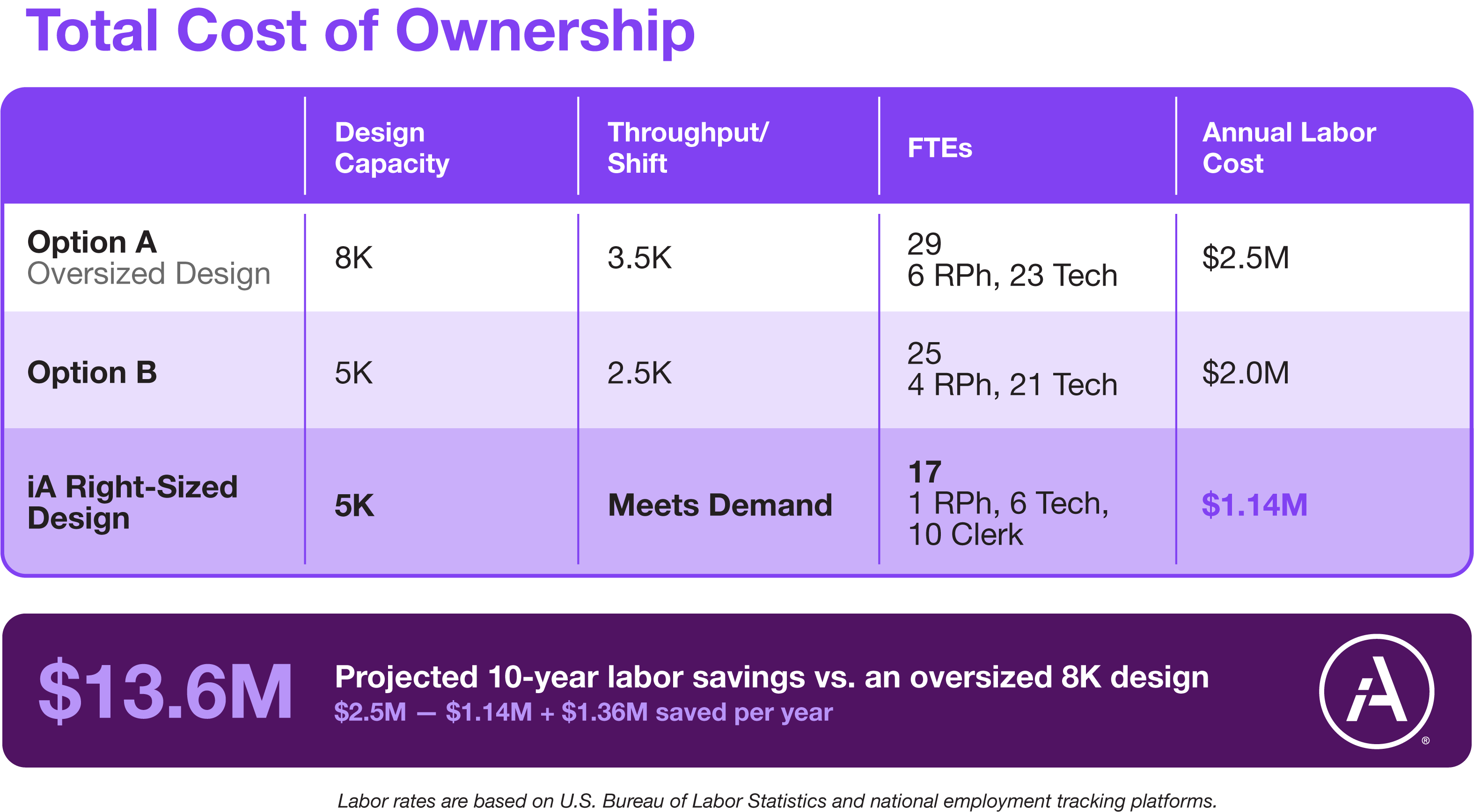
The gap between the oversized design and the right-sized one is $1.36M a year in labor. Over ten years, that’s roughly $13.6M in the customer’s favor. This number won’t be considered if you only compare equipment costs.
Three questions to consider when comparing vendors:
- What staffing model does the throughput number assume? Throughput per shift means little without the headcount behind it. Ask for FTEs by role, not just totals. The pharmacist and technician mix will matter.
- Is the design properly sized to your demand, or to a bigger number? Is it factoring in your plans for growth? Excess capacity isn’t free. An oversized design can carry its own staffing and operating overhead even when it isn’t running at the volume it was built for.
- Are you funding automation you’d get little value from at your volume? This is where the unit of use question comes in.
The lowest proposal and the lowest total cost are rarely the same, and the difference is usually made in labor. A system that looks affordable at signing can become the most expensive one you own once you add up a decade of staffing, overhead, and capacity you never use. Before you decide, put FTEs by role, throughput, and annual labor cost next to the capital number for every vendor, and model all of it over the full life of the system. The right fulfillment partner will be glad to show their staffing assumptions, and the numbers will tell you which design fits your volume and your plans for growth.
Want to see how these numbers look at your volume? Contact iA to model your own comparison.