One of the most important parts of prescription fulfillment is verification, a rigorous multi-step process used by pharmacists and pharmacy technicians to confirm the clinical, legal and logistical accuracy of a prescription before dispensing. It’s required for patient safety in that it prevents errors related to drug identity and dosage. As pharmacy operations continue to evolve, especially in high-volume, automated environments, leaders are rethinking how verification fits into the workflow. One concept gaining traction is inherited verification.
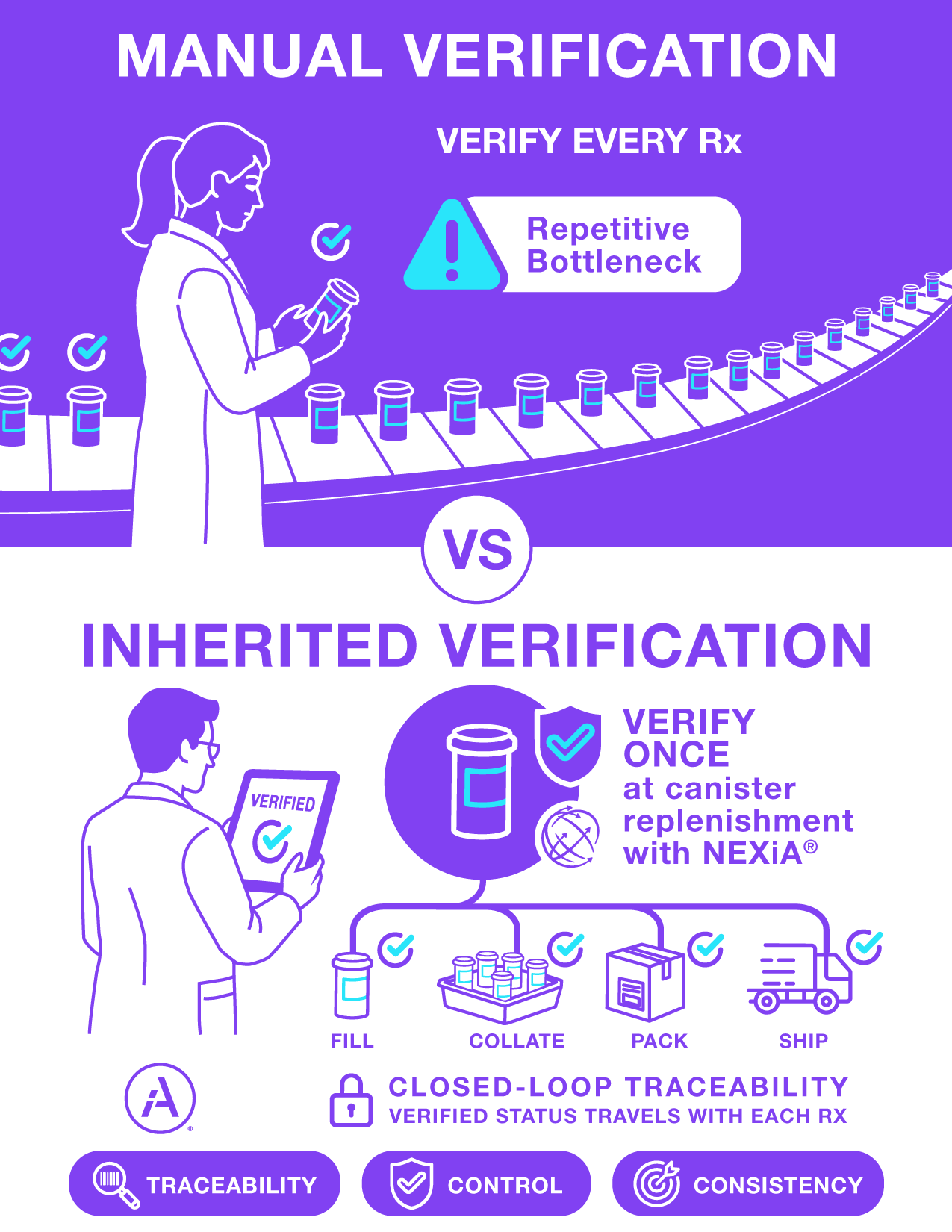
Inherited verification (also known as canister-inherited verification) is a workflow approach where a prescription is verified once early in the fulfillment process, and that verified status carries forward through downstream dispensing processes.
In automated fulfillment, this occurs with canister replenishment. A pharmacist performs digital verification, using captured images and even sometimes done remotely, to confirm the accuracy of the medication loaded into the system. Once verified, prescriptions filled from that canister can inherit that verified status as they move through fulfillment.
Rather than verifying each prescription individually, the system applies that upstream verification across downstream steps while maintaining control and traceability throughout the process.
Q: How does inherited verification work in an automated environment?
Inherited verification relies on using a closed loop system that preserves the connection between the verified source and each prescription it fulfills.
In these environments:
- A canister is replenished and digitally verified, establishing a known good inventory state
- The system tracks which prescriptions are filled from that specific canister
- As prescriptions move through filling, collation and packing, their verified status travels with them
- If any condition changes—such as a replenishment event or discrepancy—the system can pause inheritance and route the item for review
This creates a closed-loop process where verification is not just performed once, but continuously supported by system-level controls and traceability.
Q: Why does this “verify once” approach hold up operationally?
The strength of inherited verification comes from consistency and control.
Because the verification event is tied to a single, controlled source—and the system maintains that linkage throughout the workflow—the conditions that were verified remain stable. The system can effectively demonstrate that what was verified upstream is what continues through downstream processes.
Equally important, exceptions are not overlooked. When something changes, the system identifies it and prompts intervention, ensuring that verification integrity is maintained.
Q: What role does the broader system play?
Inherited verification is not a standalone feature—it depends on the capabilities of the full workflow system.
Its impact is greatest when the system:
- Coordinates processes from fill through collation, packing and sortation
- Maintains item- and order-level traceability throughout fulfillment
- Uses system-directed routing to guide prescriptions through each step
In these environments, prescriptions can move seamlessly between stages with minimal manual intervention, enabling upstream verification to carry forward reliably.
Q: What operational value does inherited verification provide?
Inherited verification supports several key areas of pharmacy performance:
- Operational efficiency: By reducing the need to verify each prescription individually, it helps streamline workflows and minimize interruptions.
- Throughput: Eliminating redundant verification steps can help maintain flow in high-volume environments such as central fill or mail-order operations.
- Workforce optimization: Pharmacists can focus more on exceptions and higher-value clinical activities rather than routine verification tasks.
- Scalability: Operations can grow without requiring a proportional increase in verification labor, supporting more sustainable expansion.
- Consistency: Standardized, system-directed workflows reduce variability compared to repeated manual checks.
For example, in environments using inherited verification, pharmacists are no longer required to verify every prescription coming off an automated filling work center—freeing up time for more critical interventions.
Q: What happens without inherited verification?
In workflows that rely on repeated, manual verification at multiple steps, several challenges could emerge:
- Increased labor requirements, with pharmacists involved in routine checks across the process
- Slower throughput, as verification could become a bottleneck
- Limited scalability, where growth could require additional staffing
- Fragmented workflows, with disconnected verification points
- Greater operational complexity and variability
These constraints could become more pronounced as prescription volumes increase.
Conclusion
Inherited verification is not just a feature. It’s a workflow strategy, where value can be realized when verification is performed upstream and the system maintains control and traceability. When these elements come together, inherited verification can help enable more efficient, scalable pharmacy operations.